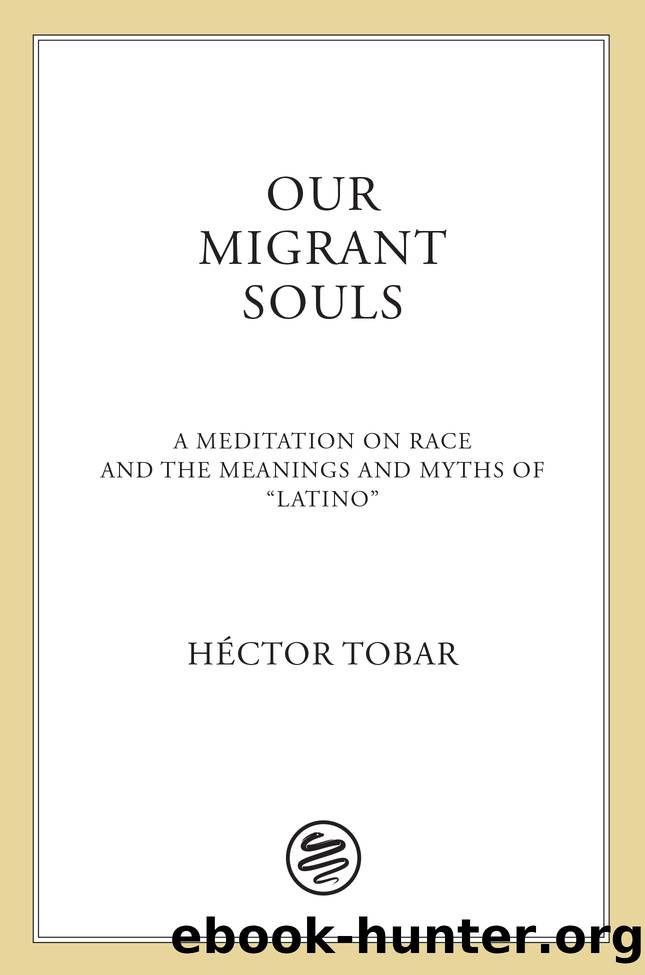
Our Migrant Souls by Héctor Tobar
Author:Héctor Tobar
Language: eng
Format: epub
Publisher: Farrar, Straus and Giroux
* * *
One of the qualities of being âLatinoâ is that you eventually come to feel the tortured and strange history of the âLatinoâ past at work inside you, shaping your understanding of the world. You somehow assimilate this knowledge, even if you never go to college, or graduate from high school, or learn to read and write. Our sense of ourselves as characters in an ongoing melodrama expresses itself in our wariness to certain kinds of situations, in our melancholia, in a tendency to value family ties, and many other ineffable qualities that are often called âspiritual.â Over the course of many centuries, the emotional and physical violence that created our ethnic and racial and caste identities (âIndian,â âpeon,â âbracero,â âundocumentedâ) have left their mark on our way of being, our conception of what our humanity is and might be. We feel wounded or not whole, so we begin asking questions of our relatives, and we assemble genealogies and read books. Or sometimes we simply take a moment at the Thanksgiving table, or at a Christmas gathering, or at a baptism party, to look at the people around us, to listen to them, to take in the shapes of their faces and their eyes and noses, and the sounds of their voices, and to wonder: Where did we come from? And what, exactly, did we suffer deep in a history unknown and invisible to me?
Latino people construct their understandings of themselves is all sorts of roundabout ways. One of my students describes her motherâs obsession with the 1948 Mexican film Angelitos negros, a tale of a fair-skinned woman with a Black mother in her hidden past, because this story echoed the race secrets and the colorism in her own family. Or we might have an accidental encounter with an old friend, or a conversation with a sibling or a cousin that brings a distant memory into sharper focus. When I was an adolescent, I listened to my father recount the events leading up to the 1954 coup in Guatemala, and his memory of the bombs that fell in Guatemala when he was thirteen years old, and this helped me understand where my family fit in the history of the world. At about the same time, I was absorbing lessons about race-thinking from my American television set. I heard about a country where ancient âraceâ hatreds gave birth to a system of industrialized mass murder. This was the same, faraway European horror story that worried Frida Kahlo as she scanned the newspapers in her Mexico City studio in 1933 and 1941, and the same one just about every American grows up learning about in the twenty-first century.
Download
This site does not store any files on its server. We only index and link to content provided by other sites. Please contact the content providers to delete copyright contents if any and email us, we'll remove relevant links or contents immediately.
| Anthropology | Archaeology |
| Philosophy | Politics & Government |
| Social Sciences | Sociology |
| Women's Studies |
Cecilia; Or, Memoirs of an Heiress — Volume 1 by Fanny Burney(32562)
The Great Music City by Andrea Baker(32023)
Cecilia; Or, Memoirs of an Heiress — Volume 2 by Fanny Burney(31959)
Cecilia; Or, Memoirs of an Heiress — Volume 3 by Fanny Burney(31945)
We're Going to Need More Wine by Gabrielle Union(19052)
All the Missing Girls by Megan Miranda(16050)
Pimp by Iceberg Slim(14522)
For the Love of Europe by Rick Steves(14174)
Bombshells: Glamour Girls of a Lifetime by Sullivan Steve(14081)
Norse Mythology by Gaiman Neil(13376)
Talking to Strangers by Malcolm Gladwell(13376)
Fifty Shades Freed by E L James(13247)
Mindhunter: Inside the FBI's Elite Serial Crime Unit by John E. Douglas & Mark Olshaker(9347)
Crazy Rich Asians by Kevin Kwan(9297)
The Lost Art of Listening by Michael P. Nichols(7509)
Enlightenment Now: The Case for Reason, Science, Humanism, and Progress by Steven Pinker(7316)
The Four Agreements by Don Miguel Ruiz(6770)
Bad Blood by John Carreyrou(6626)
Weapons of Math Destruction by Cathy O'Neil(6284)
